

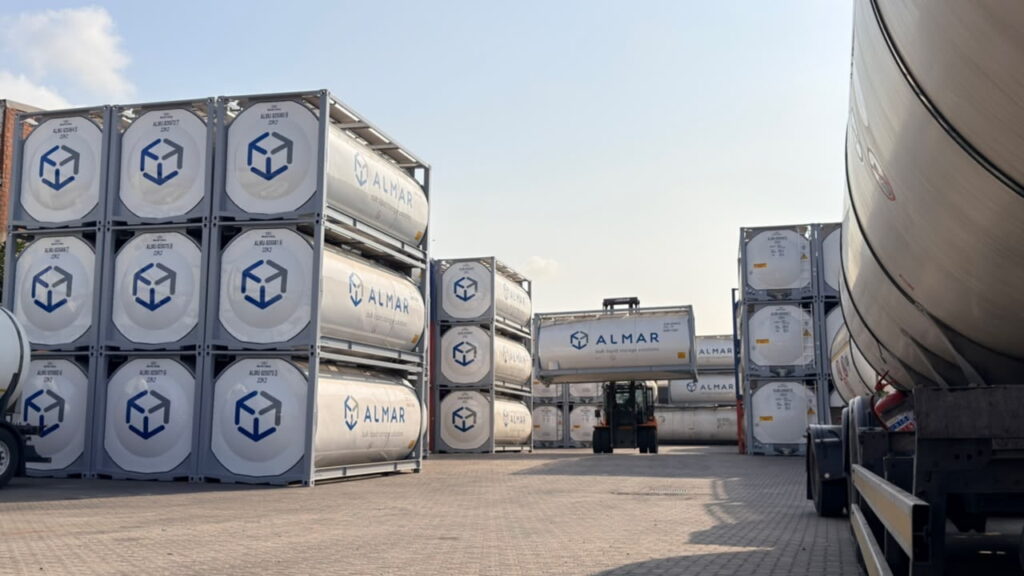
When a project requires a large number of ISO Tanks within a tight timeframe, having the tanks available is only one part of the equation.
Recently, the Almar team prepared and released 63 ISO Tanks over just two days, destined for a waste disposal project in Mozambique.
The project had been months in the planning, with the final two-day window bringing together the tanks, preparation and coordination needed to get all 63 units ready.
It was a significant requirement – and a good example of how ISO Tanks can support projects where large volumes of liquid need to be safely contained and managed.
ISO Tanks are designed for the safe storage and movement of a wide range of bulk liquids, including certain types of liquid waste.
Unlike smaller storage methods such as drums or IBCs, an ISO Tank provides substantial capacity within a single unit. This can reduce the number of individual containers required on larger projects and simplify the handling of bulk liquids.
Their robust stainless-steel construction, protective frame and internationally standardised design also make them well suited to demanding industrial and project environments.
The suitability of an ISO Tank will always depend on the liquid being stored, and the correct tank specification must be confirmed for the product concerned.
One of the advantages of ISO Tanks is the ability to scale storage capacity according to the needs of a project.
For smaller requirements, this may mean only a handful of tanks. For larger industrial, mining, environmental or project-based requirements, considerably more capacity may be needed.
In this case, 63 ISO Tanks were prepared within a two-day release period.
Projects of this scale require planning well before the tanks leave the depot. Tank availability, condition, inspections, preparation and project timelines all need to come together to meet the required schedule.

ISO Tanks are widely used across industries for the storage of bulk liquids, including:
Their reusable design also makes them a practical alternative to using large quantities of smaller packaging for suitable bulk liquid applications.
For businesses with changing project requirements, leasing ISO Tanks can provide additional flexibility, allowing the number of tanks in use to increase or decrease as requirements change.
Seeing 63 ISO Tanks lined up and ready to move gives a much better sense of the scale of this project than numbers alone.